Rooted in the Block: How Hyper-Local Strategy Turns Your Nearest Neighbors Into Your Most Loyal Customers

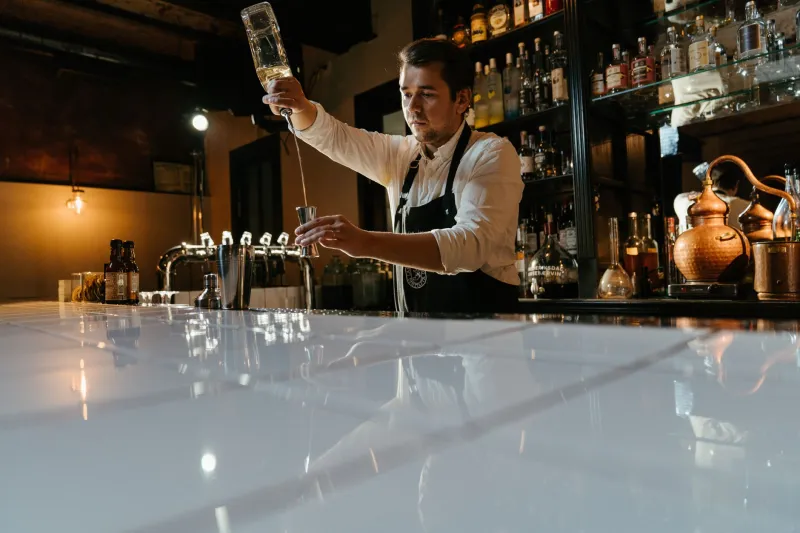
Photo by Photo by Daniel on Unsplash on Unsplash
There is a persistent assumption embedded in much of the hospitality marketing content circulating online: that a bar's goal is to draw the widest possible audience. Paid social campaigns, influencer partnerships, and SEO strategies designed to attract visitors from across town—or across the city—dominate the conversation. For larger venues with the budget and capacity to support that kind of reach, the logic holds.
For a small bar operating within a specific neighborhood, however, that assumption may be quietly working against you.
The economics of a neighborhood bar are fundamentally different from those of a destination venue. Your sustainable revenue base is not built on viral moments or one-time visitors. It is built on the people who live within walking distance, who pass your sign on the way to the grocery store, and who are quietly deciding—week after week—whether your establishment deserves a share of their routine. That decision is rarely made on the basis of a clever ad. It is made on the basis of how connected they feel to what you have built.
This is the case for hyper-local positioning: not as a fallback for operators who cannot afford broader marketing, but as a deliberate strategic choice that leverages what chains and destination bars structurally cannot replicate.
Understanding What "Hyper-Local" Actually Means in Practice
Hyper-local positioning is not simply about being close to your customers. It is about being known to them—and more importantly, being known as theirs. This distinction matters because proximity alone does not generate loyalty. There are likely chain establishments within the same radius as your bar that offer consistent pricing, national brand recognition, and extended hours. If geography were sufficient, those competitors would already have the market.
What they cannot offer is genuine embeddedness in a specific community. They cannot employ the neighbor who grew up three streets over. They cannot display work from the local artist whose studio is around the corner. They cannot remember that a regular's daughter just graduated, or that the couple at the end of the bar met here two years ago.
Hyper-local strategy is the intentional cultivation of those connections—turning them from happy accidents into operational priorities.
Cultivating Regulars as a Business Function, Not a Social Outcome
Most bar owners understand intuitively that regulars are valuable. Fewer treat their development as a systematic business function.
Consider what a regular actually represents in financial terms. A customer who visits twice per week, spending an average of $35 per visit, contributes roughly $3,600 in annual revenue. Multiply that by a dozen such customers and the figure becomes meaningful. More importantly, regulars reduce your dependence on unpredictable foot traffic and lower the effective cost of customer acquisition to nearly zero.
Developing regulars requires more than being friendly. It requires:
- Staff who remember names and preferences. This is not a soft skill—it is a service standard that should be trained and reinforced. A customer who is greeted by name and whose usual order is recalled without prompting has received something no chain can manufacture at scale.
- Consistent availability. Irregular hours, frequent closures, or staffing that results in dramatically different experiences from visit to visit erodes the sense of reliability that regulars depend on.
- Low-friction recognition. Simple systems—whether a notes field in your POS, a staff communication board, or a regular check-in during pre-shift meetings—ensure that institutional knowledge about your best customers does not walk out the door when an employee leaves.
Partnering With the Businesses Around You
Your bar does not exist in isolation. It exists within a commercial ecosystem—dry cleaners, coffee shops, gyms, barbershops, restaurants, and boutiques that share your customer base and face many of the same challenges of competing against larger operators.
Cross-promotional partnerships with neighboring businesses are among the most cost-effective tools available to a small bar. The structure can be simple: a coffee shop includes your happy hour card in their morning bag orders; you display their loyalty punch cards on your bar top. A nearby gym offers a post-workout discount to your establishment; you promote their membership deals on your chalkboard.
Beyond promotions, consider more substantive collaborations:
- Joint events. A local bookstore co-hosting a reading night at your bar, or a nearby restaurant partnering for a ticketed dinner-and-drinks experience, creates programming neither party could execute as effectively alone.
- Shared sourcing. If a neighboring restaurant purchases from a local farm or specialty food producer, exploring whether you can access the same supplier reinforces your local identity while potentially improving your purchasing terms.
- Referral relationships. A formal or informal agreement with complementary businesses—where staff actively recommend each other to customers—costs nothing and builds goodwill within the commercial district.
These partnerships also carry a secondary benefit: they signal to the neighborhood that your bar is invested in the community's broader commercial health, not merely extracting revenue from it.
Creating Reasons for Locals to Choose You Over the Chain Down the Street
Chain bars and casual dining concepts with full bar programs compete on predictability, price point, and brand familiarity. These are real advantages. Your counter-strategy should not attempt to match them on those dimensions—it should make those dimensions feel insufficient.
Several approaches have proven effective for independent neighborhood bars:
Localized programming. Trivia nights, open mic events, and watch parties are common. What distinguishes a neighborhood bar's version of these is specificity. A trivia night with a round dedicated to local history, neighborhood landmarks, or city-specific culture creates an experience that a national chain cannot replicate—and that your regulars will feel ownership over.
Community board and recognition practices. Physical acknowledgment of the neighborhood—photos, sports league schedules for local teams, notices of community events—turns your walls into a reflection of the people who drink there. This is not decoration; it is a statement of identity.
Selective involvement in local causes. Participating in neighborhood association meetings, sponsoring a local Little League team, or hosting a fundraiser for a nearby school positions your bar as a stakeholder in the community, not merely a vendor within it. This kind of involvement generates goodwill that is difficult to quantify but consistently cited by regulars as a reason they feel loyalty to a particular establishment.
The Competitive Moat You Are Building
The strategic logic underlying hyper-local positioning is straightforward: you are building a competitive advantage that is inherently difficult to copy. A national chain can match your beer prices. It can run a happy hour. It can install a jukebox and put a game on the television. What it cannot do is become genuinely woven into the fabric of a specific neighborhood.
That embeddedness—the sense among locals that your bar is part of where they live—is not built through a single campaign or initiative. It is built through accumulated decisions: who you hire, what you display on your walls, which events you host, which neighboring businesses you support, and how your staff treats the person who comes in alone on a Tuesday.
For small bar operators, that accumulation is not a limitation. It is the product. And it is one that no amount of marketing spend from a competitor can easily displace.