The Quiet Margin Drain: How Cocktail Inconsistency Is Costing Your Bar More Than You Realize
There is a category of financial loss that rarely appears on any bar's profit and loss statement, yet it influences nearly every revenue line on that document. It does not show up in your weekly inventory variance report. It is not captured by your pour cost percentage. And it almost never surfaces in a post-shift conversation with your team. It is the cost of making the same drink differently every time it is ordered — and for most small bar operations, that cost is far larger than owners estimate.
Inventory shrink gets attention because it is visible and measurable. Pour cost gets attention because it is a standard industry benchmark. Cocktail inconsistency, by contrast, is diffuse. Its damage is spread across customer satisfaction scores, comp tabs, and the quiet erosion of repeat visit frequency — none of which appear on a single line you can easily audit. That is precisely what makes it dangerous.
What Inconsistency Actually Looks Like on Your Floor
Consistency problems in cocktail execution take several forms, and not all of them are obvious. The most visible version is the drink that tastes noticeably different depending on who made it — stronger on Tuesday nights when one bartender is working, weaker on Friday when another is behind the stick. Guests notice this even when they cannot articulate it precisely. What they experience is a product that does not meet the expectation set by their last visit.
Less visible, but equally damaging, is inconsistency in presentation and preparation method. A cocktail that is sometimes shaken and sometimes stirred, sometimes garnished one way and sometimes another, communicates to the guest that your operation lacks a defined standard. That perception is not neutral. It undermines the perceived value of the drink at the price point you have set.
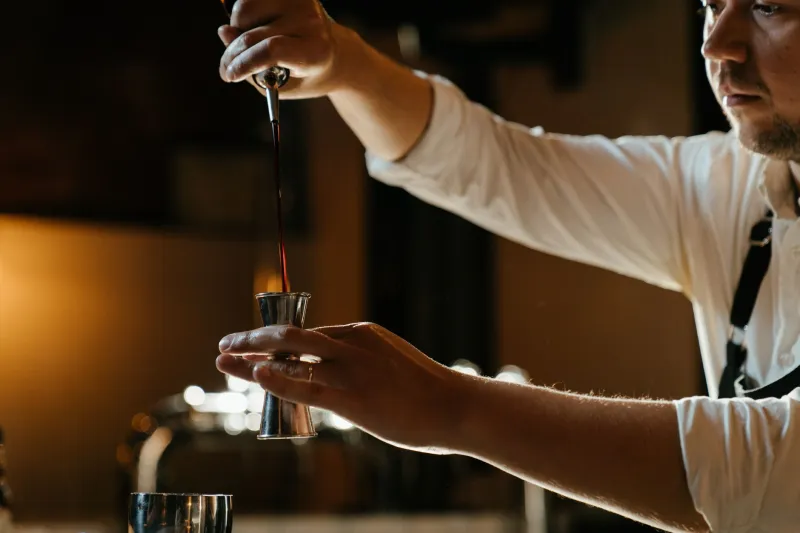
There is also inconsistency in timing and yield. When one bartender free-pours and another uses a jigger, the result is not merely a variable cost per drink — it is a variable guest experience. The guest who receives a generous pour one visit and a measured one the next does not interpret this as operational precision. They interpret it as inconsistency, and they may attribute it to the bar rather than to the individual bartender.
Translating Variation Into Dollars
To understand why this matters financially, consider the full chain of consequences that follows a single substandard drink experience.
The most immediate cost is the comp. When a guest expresses dissatisfaction — whether directly to a bartender or indirectly through visible disappointment — the standard response is to replace the drink or discount the tab. That comp eliminates the margin on the original drink and, in many cases, the replacement as well. Depending on your volume, even a modest comp rate of two to three drinks per shift can represent a meaningful monthly cost that never gets categorized as a consistency problem.
Beyond the immediate comp, there is the cost of the visit that does not happen. A guest who receives a drink that does not match their prior experience is statistically less likely to return at their previous frequency. For a neighborhood bar or any operation that depends on a loyal local base, the revenue value of a regular guest over twelve months is substantial. Losing even a fraction of that visit frequency across a meaningful portion of your regulars compounds into a significant annual revenue gap — one that is invisible in any single week's numbers but very real across a quarter.
Finally, there is the reputational cost. In an environment where guests routinely share experiences through online reviews and social media, a pattern of inconsistent quality generates negative signal in the channels your prospective guests consult before choosing where to spend. This is not a hypothetical risk. It is a documented behavior pattern, and it disproportionately affects independent bars that lack the brand recognition to absorb negative sentiment the way larger chains can.
Auditing Your Consistency Gap
Before you can address inconsistency, you need to measure it. Most bars have no formal mechanism for doing so, which means the first step is building one.
Start with your top ten selling cocktails by volume. These are the drinks your guests order most frequently and therefore the drinks where inconsistency has the greatest cumulative impact. For each of these, document the current state of execution across your staff by having each bartender prepare the drink independently, without reference to a written recipe. Measure the result: total volume, individual ingredient quantities, preparation method, and presentation. Record what you find.
The variation you observe is your baseline consistency gap. In most small bar environments that have not implemented formal recipe standards, this gap is wider than ownership expects. Differences of fifteen to twenty-five percent in key ingredient ratios are common. Preparation method variations — shaken versus stirred, double-strained versus not — are frequently present even on drinks with established reputations.
Once you have your baseline, calculate the cost impact. Assign a cost-per-drink to the highest and lowest execution of each cocktail based on actual ingredient quantities observed. The spread between those two figures, multiplied by the weekly volume of that drink, gives you a rough measure of the cost variance driven purely by inconsistency. Add an estimated comp rate and a conservative estimate of repeat visit impact, and the total figure becomes considerably more compelling.
Building Standards Without Eroding Culture
The resistance most bar owners anticipate when implementing recipe standardization is real, but it is manageable. Experienced bartenders often interpret standardization as a constraint on their craft, and that perception — if not addressed directly — will produce passive non-compliance that undermines the entire effort.
The most effective approach reframes standardization as a floor, not a ceiling. The standard recipe defines the minimum repeatable execution that every guest can expect on every visit. It does not prohibit a skilled bartender from expressing technique, personality, or creativity within that framework. What it does prohibit is variation that degrades the guest experience or erodes the bar's margin.
Involve your senior staff in the recipe development process. When experienced bartenders contribute to the standards they are expected to execute, ownership of those standards shifts from management to the team. The result is a specification that reflects genuine craft knowledge rather than an arbitrary document imposed from above.
Document everything in a format that is accessible during service — laminated recipe cards, a shared digital reference, or a dedicated prep sheet. Conduct periodic calibration sessions where the team prepares standard drinks together and evaluates the results against the defined specification. Treat this as a professional development exercise rather than a compliance audit, and the cultural resistance diminishes considerably.
The Compounding Return on Consistency
The business case for cocktail standardization is not merely about preventing loss. It is about building the operational foundation that allows your pricing strategy to hold.
When every guest receives the same drink at the same quality level on every visit, your menu price reflects a reliable value proposition. That reliability is what converts a first-time visitor into a regular, and a regular into an advocate. It is also what allows you to raise prices with confidence — because the product you are charging more for is consistently worth what you are asking.
For small bar owners operating on the margins that define this industry, that compounding return is not a secondary benefit. It is one of the most durable competitive advantages available, and it begins with the decision to take consistency seriously as a financial discipline rather than treating it as a matter of craft alone.